


May 21, 2026
By: Roger Handberg and Julie Posteraro | Originally published in The Florida Bar's Health Law Section May 2026 Health Law Update
Almost every summer, the United States Department of Justice (DOJ) issues a press release about its “national takedown,” consisting of healthcare fraud prosecutions across the country. Then, after the close of the federal government’s fiscal year in September, the DOJ publicizes the results of its affirmative civil enforcement efforts, with an emphasis on healthcare fraud-related cases.
The statistics summarized in those press releases are impressive. The most recent press releases are good examples. Last June, DOJ announced 324 defendants had been charged for their roles in healthcare fraud schemes totaling more than $14.6 billion in intended loss.1 In January 2026, the DOJ touted False Claims Act settlements and judgments in excess of $6.8 billion for Fiscal Year 2025.2
A review of the data regarding criminal and civil healthcare fraud enforcement efforts reveals several patterns over the past couple of years. In criminal cases, the number of healthcare fraud prosecutions has dropped by approximately 54% from 2017 to 2025, while the median loss in those prosecutions has more than doubled. These trends mirrored what occurred in overall fraud cases over the same time period, in which two trends operated in tandem: fewer cases were charged, but those cases involved larger amounts of loss.
As for civil enforcement, annual recoveries of more than $1 billion have been the norm since 2006, with the largest amount of settlements coming from qui tam cases. A more recent trend regards qui tam cases in which the DOJ has declined to intervene. In the past, the department’s decision not to intervene often meant the end of a qui tam case. That has long since stopped being the case. In every year since 2017, relators have successfully recovered more than $100 million in cases declined by the DOJ. And, in two of those years (2022 and 2025), relators recovered more than $1 billion, recoveries that exceeded the amounts recovered by the DOJ in qui tam cases in which it had intervened.
This article will provide an overview of these trends and what practitioners should know about their possible impact on future federal healthcare fraud enforcement.
Overview of Trends in Criminal Health Care Fraud Enforcement
In most years, the top five categories of federal prosecutions consist of immigration, drug trafficking, firearms, fraud, and sex offenses, often in that order. Since 2017, the total number of defendants federally charged has fluctuated from a high of 92,485 in 2019 to a low of 66,027 in 2023.3 Of the top five categories of prosecutions, two have decreased from 2017 to 2025 (drug trafficking and fraud), while one has experienced an increase (immigration), and two have stayed about the same (firearms and sexual offenses).4
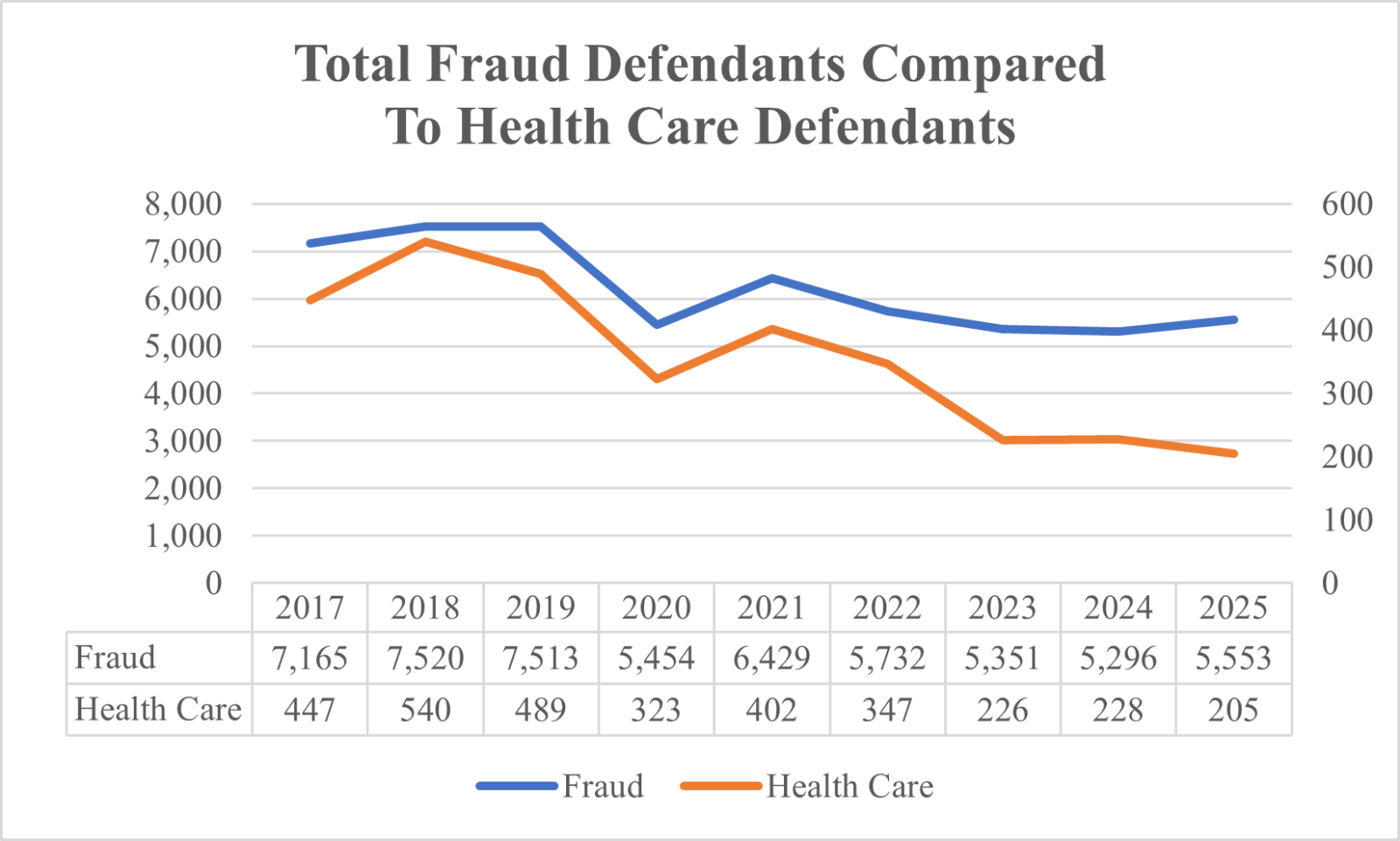
Fraud offenses are one of the categories that have experienced a decrease. In 2017, 7,165 defendants were charged in fraud cases in federal court. By 2025, that number had decreased approximately 22% to 5,553 defendants.
In the data published quarterly on the U.S. Courts’ website, the fraud category is broken down into 19 subcategories. One of those is “Health Care.” In 2017, the Health Care subcategory ranked sixth among subcategories, with 447 defendants. By 2025, the Health Care subcategory was ranked eighth, with 205 defendants, a 54% drop. As shown in the following chart, the decline in Health Care defendants mirrored the decrease in the total number of fraud defendants:
The number of defendants charged is just one measure that should be considered in reviewing prosecution trends. The reason is that a defendant charged with a $100 million loss is considered to be the same as a defendant charged in a case involving a $100 loss when only the number of cases is considered. But, those cases are not the same. In general, larger loss cases often involve more sophisticated schemes, cause greater financial harm to victims, and require more prosecutorial and investigative resources, among other things.
For those reasons and others, another measure that may assist in providing a more complete understanding of the trend in criminal prosecutions is the amount of loss. The acceptance of this measure as an indicator of the potential significance of a case is well recognized. For example, in its Justice Manual, the DOJ identifies the amount of economic harm caused by an offense as a factor to be considered in determining whether a federal prosecution will serve a “substantial federal interest.”5
Data on fraud losses also has the benefit of being readily available. On an annual basis, the U.S. Sentencing Commission reports data about the amount of median losses in healthcare fraud cases.6 A “median” loss is the middle value in a dataset of losses, with more than half the cases above that amount and half below that amount. Compared with average losses, median losses are less susceptible to being skewed by outliers.
From 2018 to 2025, the amount of median loss in fraud cases more than doubled, rising from $62,000 in 2018 to $149,856 in 2025. This trend did not always follow a straight line. In 2019 and 2020, median fraud loss decreased. It then increased every year after that.7
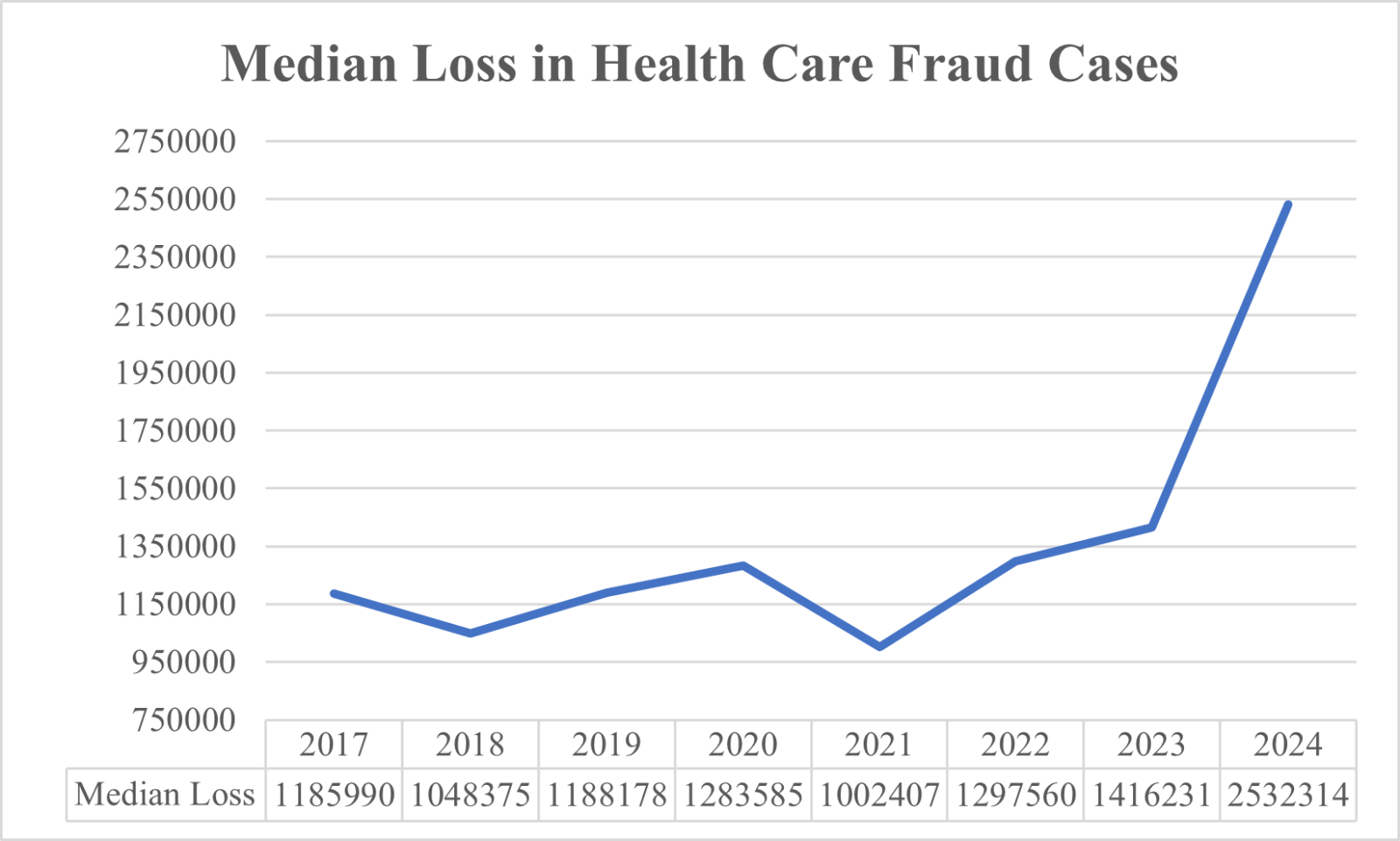
A similar trend was seen in the median fraud loss in healthcare fraud prosecutions. After fluctuating from 2018 to 2021, the amount of median fraud loss increased in every year after that, rising 29% in 2022, 9% in 2023, and 79% in 2024. In 2024 (which is the most recent year for which data is available), the median fraud loss in healthcare fraud cases was more than $2.5 million, which was more than double what it was back in 2017. The following chart reflects those trends:
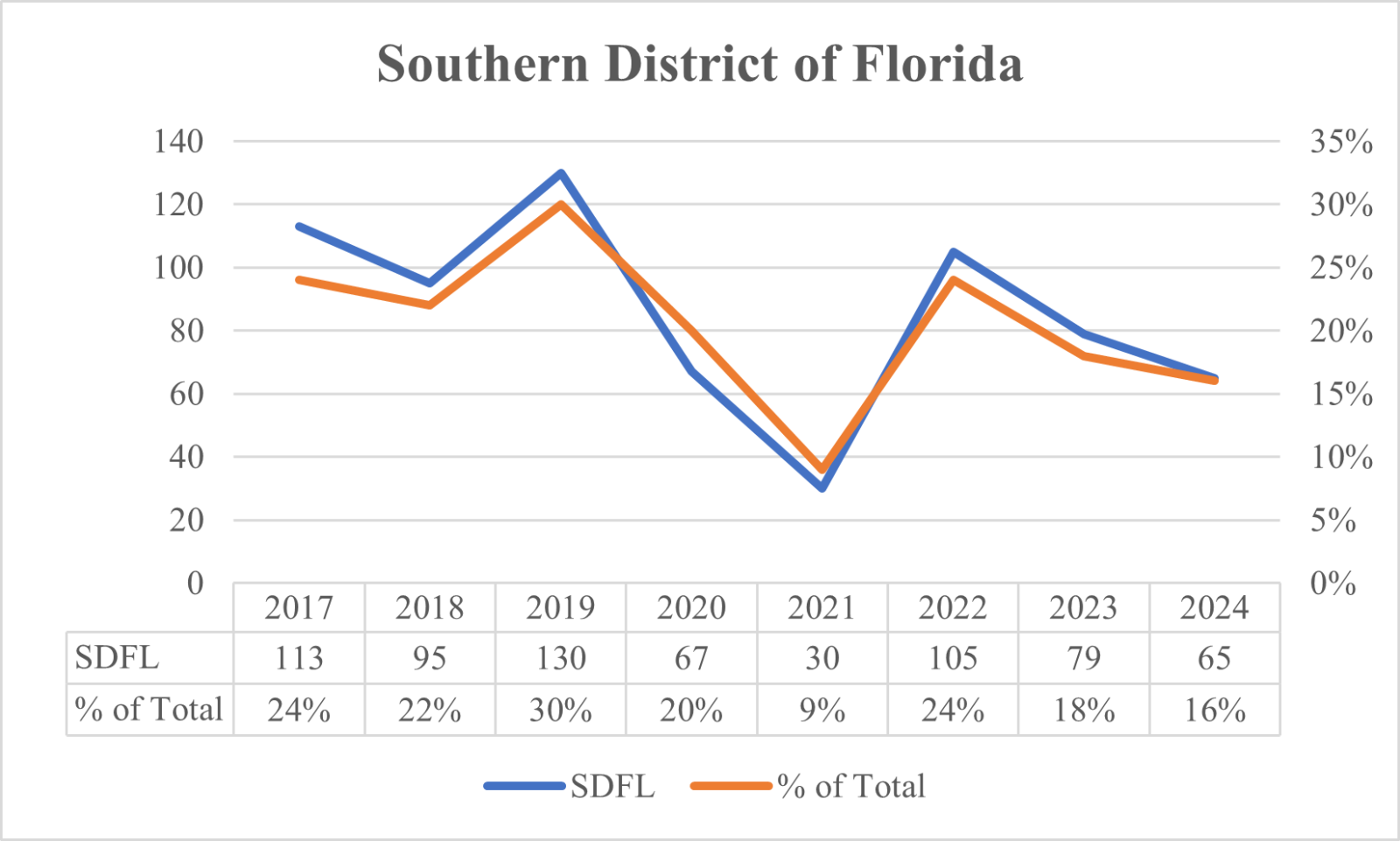
One trend that has remained consistent is that the Strike Force in the Southern District of Florida continues to be at the top in terms of the number of healthcare fraud prosecutions. From 2017 to 2024, the Southern District of Florida was the only district in the top five in the country every year for healthcare fraud cases as reported by the U.S. Sentencing Commission. In every one of those years, except for one, the Southern District of Florida had the most healthcare fraud defendants sentenced, ranging from 9% (in 2021) to 30% (in 2019) of the total number of those defendants.
This success is not unexpected. The Southern District of Florida was the location of the DOJ’s first Health Care Fraud Unit’s Strike Force back in 2007.8 Since then, the Strike Force has been expanded to Tampa and Orlando in the Middle District of Florida, and it is known as the Florida Strike Force. The following chart shows the number of healthcare fraud cases sentenced in the Southern District of Florida from 2017 to 2024, and its percentage of total cases in those years, as reported by the U.S. Sentencing Commission:
Overview of Trends in Civil Health Care Fraud Enforcement
The amount of loss has increased in criminal healthcare prosecutions. A similar trend has been seen in civil enforcement actions brought under the False Claims Act.
In general, the False Claims Act provides for two avenues for recovery: (1) the government may pursue an investigation and either settle the case or file suit, or (2) a private citizen, known as a relator, may file a “qui tam” action on behalf of the U.S. If a relator files a qui tam suit, “[a] copy of the complaint and written disclosure of substantially all material evidence and information the person possesses shall be served on the Government[.]”9 The complaint remains under seal for at least 60 days, and it is not served on the defendant. During that time period (which may be extended upon a showing of good cause), the DOJ evaluates the case and decides whether to intervene and proceed with the action or to decline intervention and allow the relator to conduct the action.10
The DOJ has published statistics on recoveries from False Claims Act investigations and cases.11 The statistics cover the period from 1987 to 2025, and they are broken down into four categories: the DOJ’s Civil Division, Health and Human Services (HHS), Department of Defense (DOD), and Other.
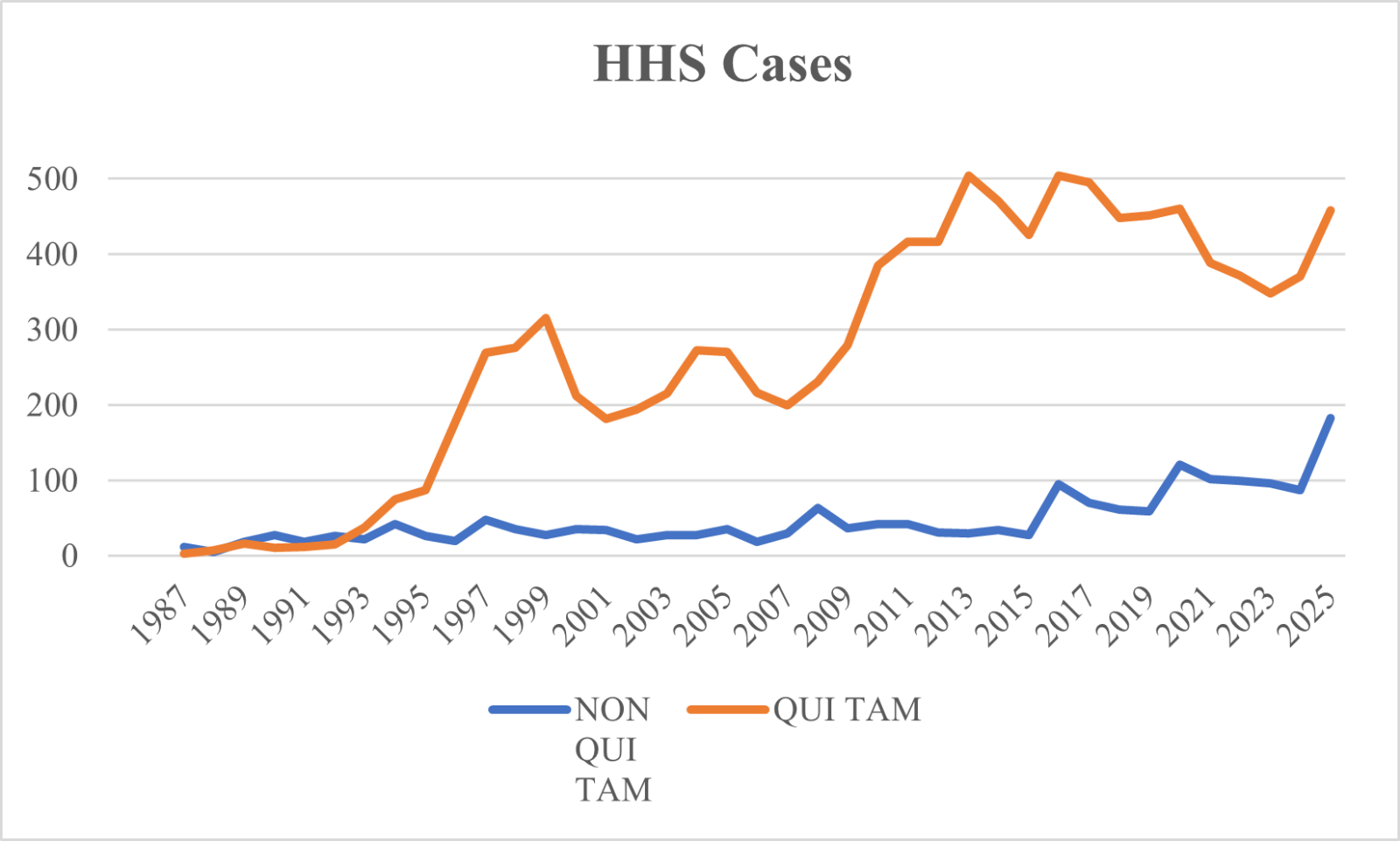
As these statistics show, it did not take long for the number of qui tam cases to increase after the 1986 amendments to the False Claims Act. From 1987 to 1994, the number of non-qui tam actions was greater than the number of qui tam actions. Since 1994, the trend has been the opposite, with the number of qui tam actions consistently exceeding the number of non-qui tam actions each year.
This trend is particularly prevalent in healthcare fraud-related matters. Using the HHS statistics as a proxy for healthcare fraud matters, the number of healthcare fraud qui tams has greatly exceeded the number of non-qui tam healthcare fraud matters every year since 1994:
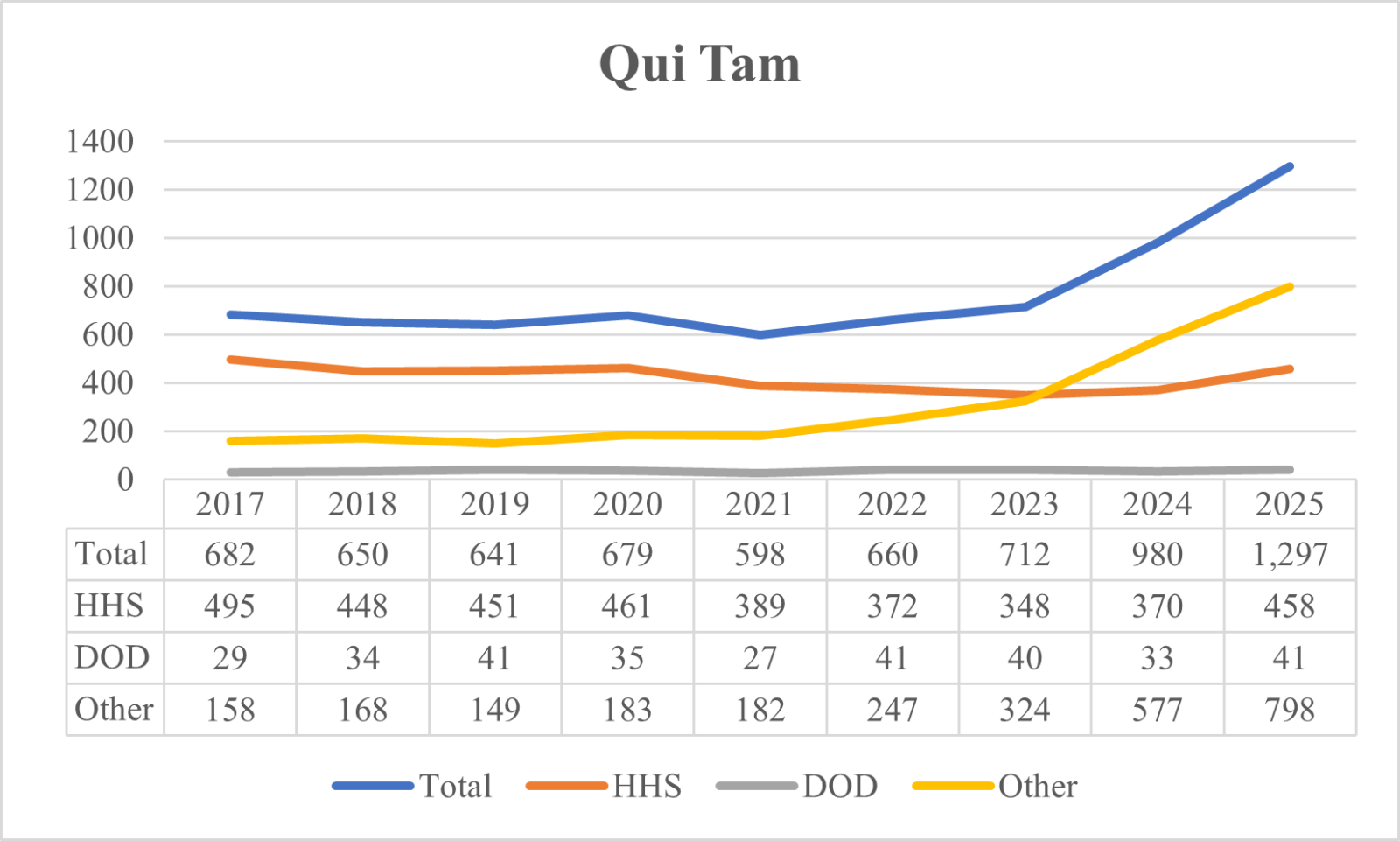
For many years, healthcare fraud qui tams were the largest component of the overall number of qui tams. This changed in 2023 as the number of qui tams in the other category began to increase (likely due to the filing of COVID fraud-related qui tams):
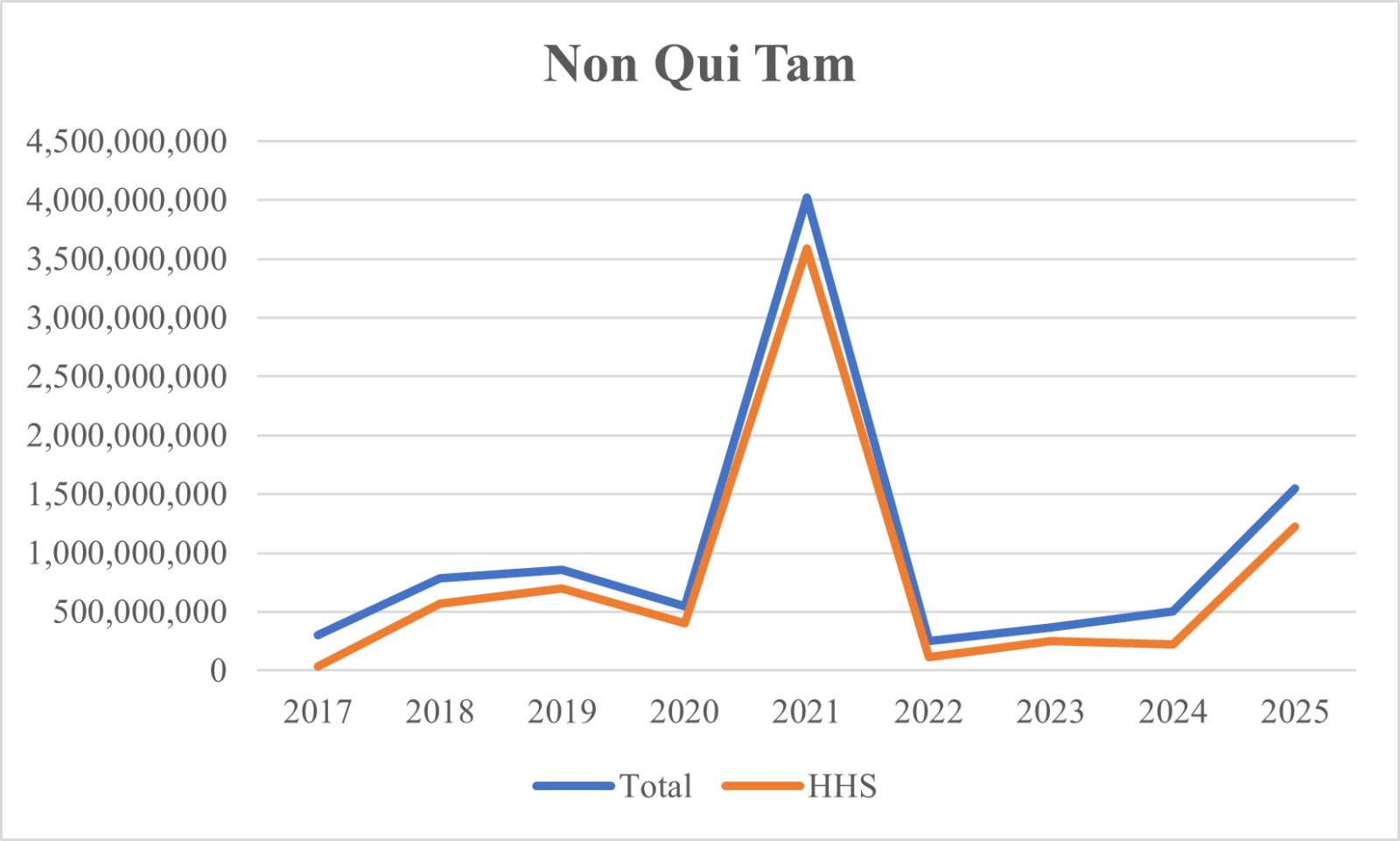
Regardless of how the data is viewed, healthcare fraud-related False Claims Act matters generate a substantial portion of recoveries almost every year. This is true for non-qui tam matters:
It is equally true for qui tam matters:
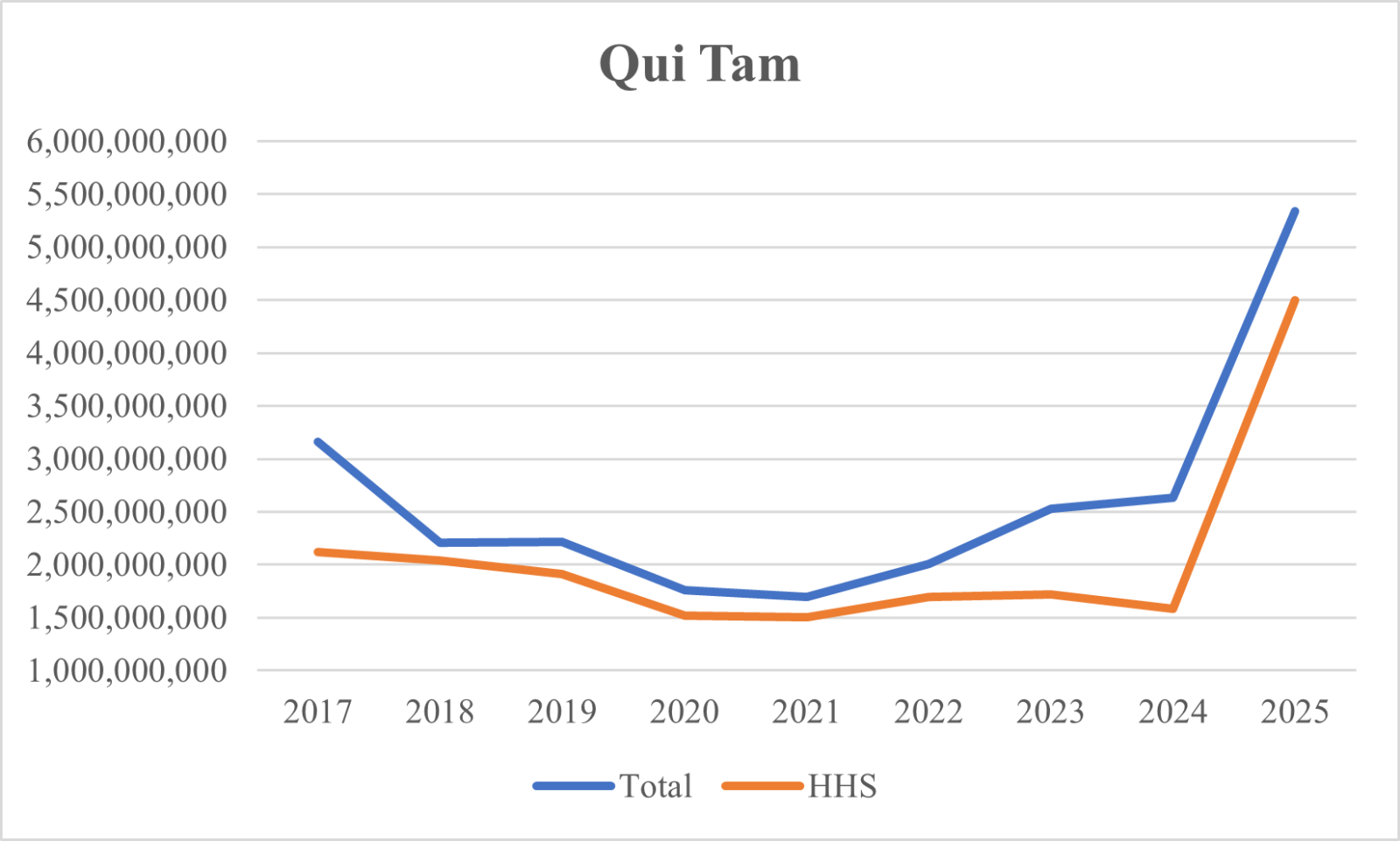
In most years, the government’s recoveries from False Claims Act investigations and cases rise and fall in tandem with the recoveries in healthcare fraud matters. But, there are two trends within this trend that are worthy of note.
First, in almost every year, recoveries in qui tam cases exceed those for non-qui tam cases. From 2017 to 2025, the total amount of recoveries in non-qui tam healthcare fraud cases exceeded $7 billion. Those recoveries were significant, but the recoveries in qui tam cases were more than double that amount, at $18.5 billion. Since 2006, there has not been a single year in which recoveries in healthcare fraud qui tam cases were less than $1 billion. By contrast, there were only three of those 20 years when non-qui tam recoveries exceeded $1 billion. With one exception (in 2021), qui tam recoveries have constituted the largest portion of False Claims Act recoveries in healthcare fraud cases every year from 1997 onward.
Second, a substantial portion of healthcare fraud qui tam recoveries are occurring in cases that were handled by relators after being declined by the DOJ. For the first 20 years or so after the 1986 amendments to the False Claims Act, it was a common assumption that a qui tam action would not succeed if the DOJ declined to intervene. The statistics supported that view. From 1987 to 2006, the largest amount of recoveries in any one year for declined healthcare fraud cases was in 2002, totaling approximately $23 million. Compared against the $937 million recovered that year from qui tam actions in which the DOJ intervened, the amount of recoveries in declined qui tam cases in 2002 was a small fraction of the overall qui tam recoveries for that year.
The first year with more than $100 million in recoveries in declined healthcare fraud qui tam cases was 2007. That year, however, was not the start of a longer trend. Recoveries dropped the following year to approximately $8 million and remained below $100 million until 2013.
In that year, recoveries in declined healthcare fraud qui tam cases topped $100 million. From that point forward, with the exception of two years (2014 and 2016, both with $75 million in recoveries), the recoveries in those cases have exceeded $100 million. From 2017 to 2025, total recoveries in declined healthcare fraud qui tam cases exceeded $5 billion, with two years recording recoveries of more than $1 billion (approximately $1,020,752 in 2022 and $2,274,416 in 2025). The recoveries in those two years, 2022 and 2025, are the only times when recoveries by relators have exceeded those by the DOJ in qui tam cases:
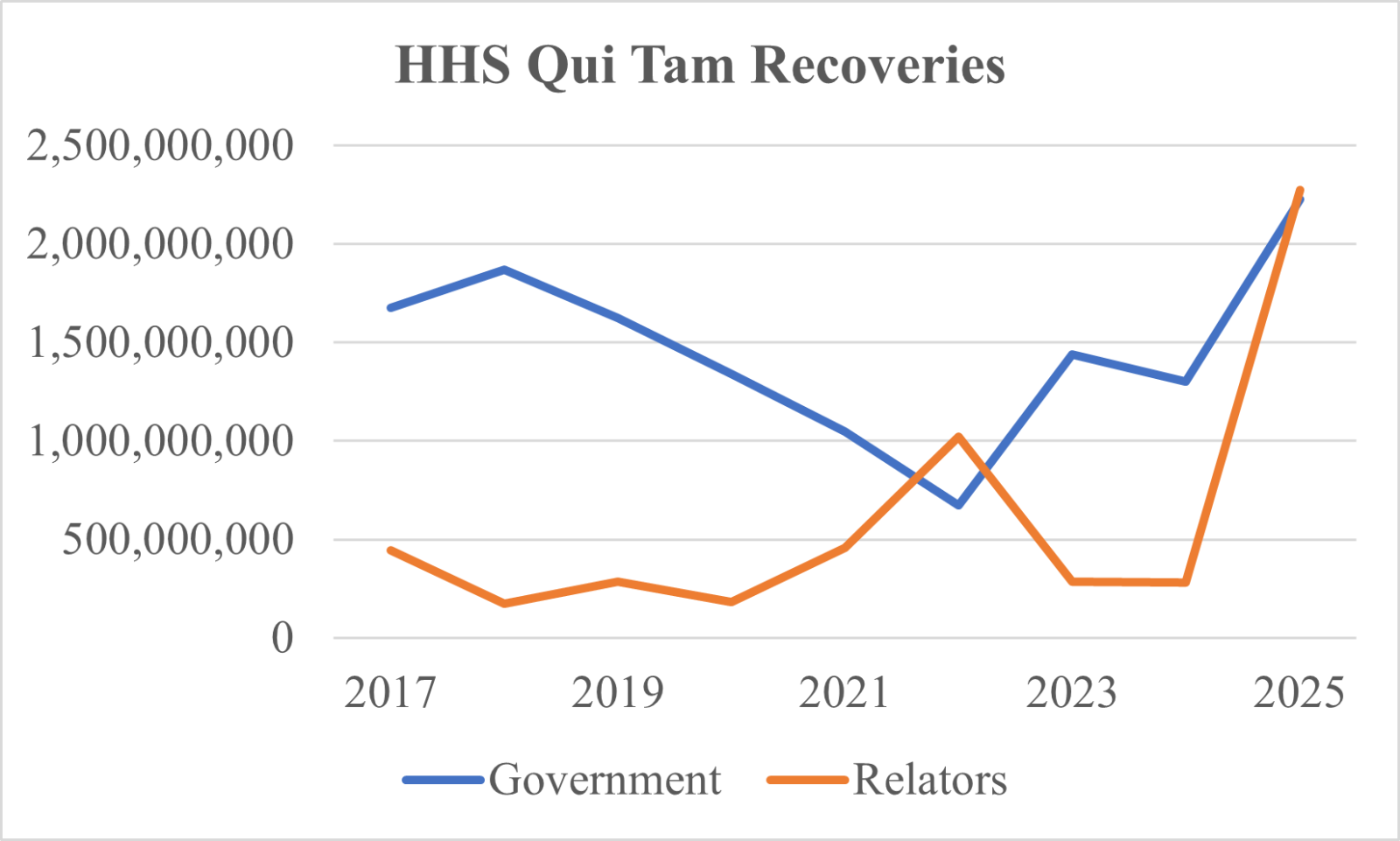
These statistics demonstrate that the DOJ’s decision as to whether to intervene is not a predictor of the potential for recovery in a qui tam case. While it may have been unlikely in the past for a relator and their counsel to seek to pursue a healthcare fraud qui tam that had been declined by the DOJ, that is no longer the case. Relators and their counsel have demonstrated the ability to use their resources effectively to identify potential violations and to pursue significant recoveries. Coupled with recoveries in DOJ investigations and cases, this trend contributed to the largest amount of total recoveries in healthcare fraud civil matters ever in 2025.
Conclusion
The trends in criminal and civil healthcare fraud enforcement should be considered together. In criminal cases, prosecutions are less likely, but the focus of the DOJ is on cases with larger financial losses. Florida continues to be a focus of healthcare fraud investigations and prosecutions, especially from the Florida Strike Force in Miami, Tampa, and Orlando.
At the same time, financial recoveries in civil cases remain significant, but most of those recoveries derive from qui tam cases brought by relators. And, of those, relators are handling more of those cases and are doing so successfully. Healthcare providers facing a False Claims Act investigation can no longer focus solely on convincing the DOJ to decline intervention.12 In addition to seeking that result, healthcare providers must be prepared to litigate the case with relators who have demonstrated the ability to obtain significant results in the cases that they have handled.
These trends in civil recoveries highlight the significance of the impending decision of the Eleventh Circuit Court of Appeals in United States ex rel. Zafirov v. Florida Medical Associates, 751 F. Supp.3d 1293 (M.D. Fla. 2024). In that case, the district court held that the False Claims Act’s qui tam provision is unconstitutional and violates the Appointments Clause of Article II.
The case is on appeal, and oral argument was held in December 2025. If the district court’s ruling is upheld, the landscape of federal civil enforcement of healthcare fraud would change dramatically.13 The government would no longer be able to rely on relators to identify potential healthcare fraud schemes through the filing of qui tam actions. Nor would it be able to count on the significant recoveries that relators have been obtaining in qui tam cases that the DOJ has declined. The DOJ would have to consider deploying additional resources to maintain the same level of financial recoveries in healthcare fraud cases.
Only time will tell if the DOJ will be placed in such a situation. If relators are no longer authorized to bring qui tam actions, federal affirmative civil enforcement would become the government’s sole responsibility. The situation in civil cases would then be similar to what it is in criminal cases, where the government is the one responsible for initiating and litigating cases in federal court. Such a change would be significant, as it would depart from the way in which False Claims Act cases are currently handled.
1 “National Health Care Fraud Takedown Results in 324 Defendants Charged in Connection with Over $14.6 Billion in Alleged Fraud,” Justice Dept. Press Release (June 30, 2025), https://www.justice.gov/opa/pr/national-health-care-fraud-takedown-results-324-defendants-charged-connection-over-146
2 “False Claims Act Settlements and Judgments Exceed $6.8B in Fiscal Year 2025,” Justice Dept. Press Release (Jan. 16, 2025), https://www.justice.gov/opa/pr/false-claims-act-settlements-and-judgments-exceed-68b-fiscal-year-2025
3 This data comes from Table D-2 of the “Caseload Statistic Data Tables” found on the U.S. Courts’ website (https://www.uscourts.gov/statistics-reports/caseload-statistics-data-tables). The data in this article is reported based on the federal fiscal year, which runs from October 1 of a year to September 30 of the following year. For example, when this article references data for 2017, that means that the data is for the fiscal year that started on October 1, 2016, and that ended on September 30, 2017.
4 The number of defendants charged with sex offenses (typically involving the sexual exploitation of children) ranged from 3,075 in 2022 to 3,513 in 2025. The number of defendants charged with firearms offenses experienced greater fluctuation, with 9,391 in 2024 and 12,479 in 2019. The number of firearm defendants was 9,525 in 2017 and 9,555 in 2025.
5 The Principles of Federal Prosecution provide: “[t]he impact of an offense on the community in which it is committed can be measured in several ways: in terms of economic harm done to community interests[.]” Just. Manual § 9-27.230.
6 Sentencing Commission data is based on sentenced cases, as opposed to the filing of charges. As a result, Sentencing Commission data cannot always be tied directly to data reported by the U.S. Courts on its website.
7 See generally Roger B. Handberg, “Fewer Smaller Cases: A Review of Trends in Federal White-Collar Prosecutions from 2017 to 2024,” Criminal Justice 17, 22 (Fall 2025).
8 “Florida Strike Force,” Justice Dept. website, https://www.justice.gov/criminal/criminal-fraud/miami-strike-force-operations
9 31 U.S.C. § 3730(b)(2).
10 It also is possible that the Justice Department may elect to intervene and “dismiss the action notwithstanding the objections of the person initiating the action if the person has been notified by the Government of the filing of the motion and the court has provided the person with an opportunity for a hearing on the motion.” 31 U.S.C. § 3730(c)(2)(A). See generally United States ex rel. Polansky v. Executive Health Resources, Inc., 599 U.S. 419, 430 (2023) (“So the Government can file a (2)(A) motion to dismiss whenever (whether during the seal period or later) it has intervened.”).
11 “FY2025 FCA Stats,” Justice Dept. website, https://www.justice.gov/opa/media/1424121/dl
12 An important part of any such representation also is considering the possibility of requesting the United States to intervene for the purposes of dismissing the case. See Polansky, 599 U.S. at 430.
13 Regardless of the result reached by the Eleventh Circuit, there is the potential for Supreme Court review of the issues raised in Zafirov in that or some other case. If the qui tam provisions are found to be unconstitutional, there also is the possibility of legislative proposals to amend the False Claims Act. Discussion of these possibilities, and the impacts they may have on federal enforcement efforts, is beyond the scope of this article.
Questions?
Contact GrayRobinson Shareholders Roger Handberg and Julie Posteraro or a member of the Litigation Section.